This campaign is so good I am speechless. The ingenuity, but more importantly the guiding cultural insight meshed with The Guardian's transformation. It is a great brief and the work is on brief. Jason Gonsalves from BBH Labs wrote an overview of The Whole Story campaign and the business strategy here. As a teaser, I pulled the video and one of the images below. But you'll appreciate it even more as a marketer if you see it all together on their site. Thank you to BBH, The Guardian and the storytellers.
___________________________________
Addition March 9, 2012:
There are amazing parallels between the Three Little Pigs piece and the real life way KONY 2012 is playing out. From the connective spread of the message to the backlash and so forth. Fascinating and timely parallel. Here is the film and a Guardian article summarizing the controversy.
A draft of this post has been sitting in the queue since I started this blog. I wanted to save it until I had some readers. And today is definitely the day. I couldn't be more excited to share.
Barbara Apple Sullivan is one of my marketing heroes. She founded her own agency Sullivan in 1990. She was an early Mad Woman let alone a woman-owned business on Madison Avenue. Amazing.
Barbara specializes in business-to-business branding. She helped teach me how to create simple, meaningful messaging and product architectures. I often use messaging platforms that we created together as "templates" to each other marketers. Over the past 20 years, she has gathered and mentored a posse of men and women who believe creativity, inspiration and business can go together, like Nicole Ferry and Diana Bach. Nicole has a fantastic quote on their site:
"Marketing is a tax you pay when your product is unremarkable" is a quote from Robert Stephens founder of the Geek Squad. It has taken on a mythic-ness across the Internet and is a particular favorite among tech companies. There is incredible power and importance in Robert Stephens' 11 words. Blasphemy from my marketing mouth? Not on your life.
However, I fear many people may be misunderstanding the importance of this statement. Marketing in his sentence literally means traditional advertising and paid media. Folks use his quote as yet another grenade in the battle between the product / tech and marketing teams (sad). When a launch fails, all too often the marketers point at the product team and vice versa (sadder). I believe the genius of the expression that "good products market themselves" is misunderstood and has a ton to do with a stage in a brand's life and the nature of the product. Google search, yes. Google wave, no. Google is now running Chrome advertising which will drive search traffic. Tivo was a truly great, leading product without successful marketing and it struggled. Segway?
Hmmm. Marketing isn't just communications. Semantics feel important here. Marketing means: listening and anticipating on behalf of customers for the development of new products, distribution to make it easy to learn about about and access them, the experience you create in their delivery and service, plus how you communicate about them. Marketing (aka branding) can be the meaning that flows through it all.
I am a marketer on the frontier of what we marketers do, and it is hard to explain my role in any traditional terms. My work crosses product and communications. With technology and customers' changing use of it, the traditional siloed roles of NPD, advertising, tech teams, etc. don't necessarily make sense. A perfect iconic example is Steve Jobs. Do you notice how the tech folks see him as their hero? And so do the designers, the distributors, the businessmen, the advertisers, and the marketers. I love that. He was all of them. Another perfect example I like to use is Facebook. Every consumer products company wants to work with Facebook right now because that's where the customers are. So who do you send to the meeting with Facebook? Are they a media partner? Are they a distribution and sales channel for your product? Are they actually part of your product (eg games, payments)? Are they servicing through your social media team? In a corporate org structure, you could imagine sending 20 people to Facebook across NPD, Advertising and Media, Servicing, etc. It just doesn't work that way anymore. Many technology companies are media companies and the more they can integrate the creation, curation or distribution of stories (aka content), the more those silo lines can blur. As the Internet of Things emerges and the Internet is embedded in more and more everyday objects like cars and cameras, the possibilities get even more amazing. "Marketing" or whatever we are going to call ourselves has to keep up. And when we mash the old roles up, it is so much fun. We're just getting started. Let me give some examples.
Media marketing is part of the product itself...
Facebook "likes" is a perfect example. As you use the Facebook platform, you are broadcasting your interests in a very branded way by Facebook. This works extremely well, because the product by its nature is social. But what about other products that aren't literally social themselves?
Threadless. They run t-shirt design competitions through an online social network. According to Bonfire Social Media, Threadless "revenue is growing 500 percent a year, despite the fact that the company has never advertised, employ no professional designers, use no modeling agency or fashion photographers, have no sales force, and enjoy no retail distribution." However, they do understand social media and have built an active, empowered following of hundreds of thousands of people. The shirts become the media. They all carry the Threadless brand.
Product is part of the media advertising...
For the launch of Jay-Z's biography Decode Jay-Z, Microsoft Bing and Random House literally took pages of his book and placed them where he grew up in NYC. The product itself became the advertisement, instead of the traditional "author head shot, cover art and launch date." It also gave a reason for customers to explore the Bing technology rather than watching a video demo. I love this campaign. (Interesting, from May 2010 to 2011 Bing gained search marketshare from Google. In May 2011, Google started their largest traditional campaign ever).
So back to Robert Stephens' and his quote that rang across the Internet world in 2008 and is still reverberating today. What I have since deduced is that Robert Stephens was working with Crispin Porter + Bogusky around that time. To break the finger pointing between the marketing, sales and tech teams at Best Buy (who purchased Geek Squad in 2002), I bet Stephens' and his agency Crispin threw a white flag up to the tech and product teams to shift the dialog away from advertising. Geek Squad spent a considerable budget on marketing, just not all on traditional paid media. They shifted the expensive television media budget to "bake the marketing" into the product experience. The branding on the Geek Squad cars, the uniforms for the agents, plus more. They had custom made shoes that left tens of millions of guerilla marketing imprints of the Geek Squad logo. This brand story is even more amazing to me because Geek Squad is a service, not a tangible product, and their service is not inherently social or embedded in tech.
Robert Stephens has a very unique understanding of branding and an amazing relationship with his marketers. You can see the irony in using Stephens' words to dismiss the true, forward looking marketing leaders, branders or the function all together. These are the types of marketers who the product and technology dreamers might want to find in their organizations--the marketers who truly respect what they do and who may even know how to read a little code.
Imagine I have a beautiful face and a big butt. Am I going to spend all of my time telling men not to look at my butt? Ironically, drawing even more attention to it as I try to downplay it. Telling them that it isn't as big as they think? In other words, actively telling them that they are wrong. Or am I going to smile? Melt the room with warm laughter. Put on lipstick and draw attention to my best feature, the one that men will love?
I believe the best marketing focuses on who you are and what you stand for, rather than what you are not. Sounds crazy, right? But think about how much marketing is based on a what a product and therefore a brand isn't. It always fascinates me.
My hypothesis is that it happens most for brands and products that customers know well. There are two instances when this really seems to kick into gear: one, a company tries to grow or expand into new categories they aren't known for or two, when they are trailing a competitor who is very clear about that competitor's strength. In both situations, the company goes into focus groups and hears customers tell them this. Not surprisingly, people's impressions are largely built on the marketing and experience that brand did to create them. All of a sudden it seems like a weakness, when it may just be the success of what they just spent time and focus creating. As their internal business goals change or a market heats up, the company may turn around for the next 5 years and tell customers that isn't "just" who they are.
Some do this evolution or entry into new areas elegantly. Google's product is synonymous with search and their brand ideal is to organize and democratize the world's information. Now they are educating about Chrome. They're doing it through stories like It Gets Better or Dear Sophie. IBM meant hardware and then they needed to reinvent themselves and reorient their brand to business services through a Smarter Planet. I am a huge fan of both of these campaigns. I know exactly what they do rationally as well as their higher purpose in the world and their ideals.
But other brands do this by focusing on the negative or even worse, being defensive about their competitor's point of difference and strength. Ironically, even though these brands are listening to customers and it may come from a good place, the intent isn't translating in execution. They are looking at the customer insight too much through the lens of their business goals, rather than their brand promise. (See earlier post Listening Wrong is As Bad As Not Listening. The best communications start with a guiding customer insight: a forward-looking, fundamental truth that connects with your customers and your brand. The guiding insight is informed from customer research, as well as a connection to a brand's promise.) And as my very refined grandmother used to say, "Sweetheart, their slip is showing" in the marketplace. Their communications can appear completely focused on the company's agenda, not the customers'. Even worse, if it orients them to their competitors instead of their unique, ownable space. And it can fall wrong if not executed well, since it sounds like the company is telling the majority of customers they are wrong. It happens all the time. Start looking for it. I call it "Not Just" or "More Than" marketing.
The most meaningful brands--and personal reputations for that matter--to me aren't built on what they aren't. They focus on what they are. What they are best at and why they are different and special. They focus on their smile.
Diet Dr. Pepper is my favorite soda of all time. I don't like to showcase negative examples ever. I just don't do it. I know somewhere there is a creative team or marketing manager proud behind every piece of work and a mother who is even prouder. I figured I could do it here for this little exception because my DP addiction probably paid for it. Thanks @EuniLuni for sending it my way. Obviously, Dr. Pepper heard in focus groups that men don't drink diet because it is "for women"...
__________________________________
Addition February 27, 2012:
This was such a perfect example from one of my favorite little places that I couldn't help but add it. You can see why customers thought for years they were just bagels. It's in their name. And then they added "more than" just bagels. But what more? dinner? lunch salads? a full bakery? delivery? a coffee shop? a convenience store? a gas station?
Mary Wells Lawrence. Her story is fascinating. It made my day. Thank you, Martha Tolosa, for bringing this to our attention. Here is the full post on Adwomen. I follow them on Twitter @Adwomen. After reading their purpose, how could you not?
Every marketer should read this. "Global replace" the words advertising agency with marketing team and clients with customers in your mind as you go. This manifesto Marketing at a Point of Change was written in 1994 by the team at HHCL, a very forward looking agency of the time based in the UK. I was still in school when it was written. Yet it is so true even now. If the trajectory of marketing change is a bullet, this feels like the gun that shot it. The bullet is still going and flying fast. One of my marketing heroes says the difference between old and young isn't age. It's that young, vibrant brands believe the future is better than the past ever was. I'm not looking backwards. I'm learning so we can propel forward. It inspires me to make things even better today and to write our manifesto for the future. Please read it now, now, now.
Marketers need real role models. Not the icons (yet), but the real marketers who they aspire to be in 5 years or the peers who make us all better. Like Tiffany Rolfe. I love that another great marketer Alisa Khan sent me a note about Tiffany as her inspiration, too.
Tiffany is super amazing because of her skill, but also because she is so generous about sharing it. She is a senior Creative Director at Crispin Porter + Bogusky. Tiffany gets attention because of her work and then uses the mic to help marketers in the making in a really authentic way. She has a sense of humor and the confidence to be kind. I love that. Here is a fantastic article she wrote in AdAge "What Can We Do About the Dearth of Female Creatives?" Her answer: "If women in management roles can mentor five other women, our ranks would swell."
Working with Tiffany was a career gift. You can see a sampling of the work we did together on the Plum Card launch where she helped bring soul to business branding. Here is some of her team's more recent work like Baby Carrots. I also pulled the guiding customer and product insights that led to the marketing strategy. I bet there is another "Tiffany" on the marketing team at Bolthouse Farms. It's cool that Tiffany inspires great creative, but even better that it ladders to a marketing strategy with a vision. If you are interested in keeping up with her (like I do), you can follow her on twitter @tifko. AdWomen also tracks her portfolio. Oh, and by the way, Tiffany is 34. What are you waiting for?
I understand that there is a gravitas to business and that people at work are busy beyond words. But why does that often translate into very rational marketing to them? Form letters. Powerpoint. Bullet lists. Stock photos.
I love that good design can be even simpler and more direct. Emotion can convey respect, trust and confidence as well as or better than a business letter. And capturing the inspiration of why people are in business can make us feel part of something bigger. Business customers are people with business needs. GE ran their iconic and successful "We Bring Good Things to Life" campaign for nearly 25 years inspiring people, even while they largely transitioned to corporate customers. Now, IBM is trying to make a "Smarter Planet".
Corporatized marketing becomes even starker when serving entrepreneurs. In trying to respect them as businesses, I often see marketing that draws from corporate tool kits. Yes, they have business needs. But they are also people who are passionate, driven, and proud to serve their own customers. Here are some examples of small business branding as food for thought.
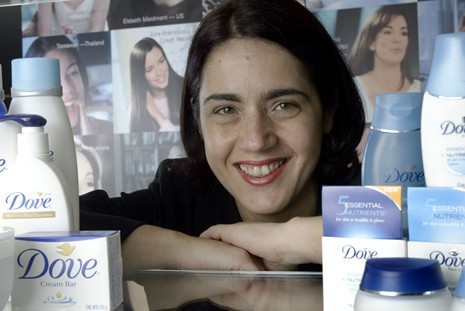
Silvia Lagnado is one of my marketing heroes. She worked at Unilever for many years shepherding the Dove brand. She created the magic of the Dove Campaign for Real Beauty with her team (who she is quick to recognize). I have had the pleasure of meeting her. She is as authentic, as passionate and as smart as you would expect.
I have learned as much from what she did at Dove as how she did it. She talks about "marketing marketing" in businesses. She makes the often misunderstood role of marketers as inspirers, interpreters and creators accessible to others, backed by her serious analytical and business chops.
This is a classic interview from 2006 conducted by Roy Young. You can see that she really listens to customers and cares. She energizes people around a bigger idea. Thank you Roy Young for capturing this moment in time. He interviewed her while researching his book on "marketing marketing." Out of respect to the source, please check it out on MarketingProfs. I hope you enjoy it as much as I do.
Profile of a Marketing Champion: Unilever's Silvia Lagnado
by Roy Young
Published on October 31, 2006
Silvia Lagnado, new group vice-president at London-based Unilever, embodies marketing championship—in particular, the ability to "span silos" by building bridges between marketing and her company's many other functions to generate cash flow. She heads a team devoted to "brand development," including conceptualizing new products and creating advertisements, packaging, and marketing strategies.
In her daily operations, she interacts with Unilever's finance, supply chain, research and development, and human resources departments. She also collaborates extensively with the many far-flung brand-building teams of salespeople and marketers operating around the world to bring the division's offerings to market.
Silvia says the most effective way to "market marketing" in an organization is to make it very personal for staff in other key positions. She advises: "Have people think about which brands they themselves really respect and which products they love—then ask them what has made them think and feel that way. They will likely discover that a marketer's efforts are behind their feelings of respect and love."
What follows is part of an interview I conducted with her to learn what makes her a Marketing Champion.
* * *
Roy Young: Tell me a bit about your background. Did you come up through the typical marketing ranks? Or was your path to where you are now more diverse?
Silvia Lagnado: I joined Unilever in 1986, in Brazil, after getting a degree in civil engineering. But I've always worked in marketing and brand development, and the work has taken me all over the world—Brazil, the United Kingdom, Argentina, and the United States.
RY: In your view, what skills have been most important to your ability to succeed on the job?
SL: I'd say it's hard work, the ability to combine strong analytical skills with intuition, the courage to take risks, integrity, and the ambition to do good work.
RY: Of all the groups with whom you and your team interact, which relationships are the most likely to experience some tension?
SL: My team's relationship with the brand-building groups is most likely to experience some tensions and complications. The brand builders are under enormous pressure to deliver our products to market every day, to both distributors and consumers. They need product mixes on time and in full from my team. If we don't have a good relationship with them, they may start perceiving us as uncommitted to the work.
RY: What steps do you take to construct a bridge between your team and the brand builders?
SL: I've found that aligning both sides behind a compelling vision is crucial. If we can both get emotionally attached to the vision—and agree on where we want to take our brands, why this is an exciting space, and how we plan to succeed there—each group can look beyond its own pressures to the more important, higher-level goals.
The Microsoft packaging team did an internal parody "If Microsoft Had Marketed the Ipod" in 2006 around the time they launched the Zune. It was meant to capture the classic tension between designers and the multiple product, marketing and sales teams who can painfully kill a design like death by a thousand paper cuts. But I always remembered the parody because it showed so clearly the differences between rational vs. emotional marketing and telling vs. showing.
DesignModo had a great post of emotional technology ads that also get across the one critical rational point of difference. I love looking at their technology examples, especially ones for business customers. Technology can be complex and takes even more discipline to be simple, to be clean, to be clear. Simplicity takes fearlessness since you have to fully commit in order for it to work. Minimalism takes so much confidence and faith in consumers' hearts and minds.


 by Alex Bogusly and John Winsor. You can also read more about the original Geek Squad branding in this 1999 article in
 .JPG)


 by Bob Lamons. It's a good, basic read. I've bought many copies and they always go missing...