Showing posts with label Emotion. Show all posts

Sunday, February 12, 2012

Barbara Apple Sullivan is One of My Marketing Heroes


A draft of this post has been sitting in the queue since I started this blog. I wanted to save it until I had some readers. And today is definitely the day. I couldn't be more excited to share.

Barbara Apple Sullivan is one of my marketing heroes. She founded her own agency Sullivan in 1990. She was an early Mad Woman let alone a woman-owned business on Madison Avenue. Amazing.

Barbara specializes in business-to-business branding. She helped teach me how to create simple, meaningful messaging and product architectures. I often use messaging platforms that we created together as "templates" to each other marketers. Over the past 20 years, she has gathered and mentored a posse of men and women who believe creativity, inspiration and business can go together, like Nicole Ferry and Diana Bach. Nicole has a fantastic quote on their site:


Thursday, November 3, 2011

Marketers as Inspirers

When someone asks me one of the proudest and most important skills I have as a marketer, I always say collaborating with creative teams to produce amazing work--some of the proudest of their careers, I always hope. Designer Murat Mutlu has this great quote on his blog: "The process of getting a bit of paper containing a brief and turning into a real life experience is pretty great." Just think, it is the marketer's brief that needs to light that fuse. This requires translating the business, simplifying the customer insight, conveying what the product does in clear way, and tying it to a higher purpose for the brand. Most importantly, it requires talking to teams in a way they will hear you. And for designers and creative teams, that means they need to feel it.

I am not going to get into the skills of writing a kick ass brief here, more on that later. But I will dwell on inspiration and the art of briefing. As I continue to (b)log the best of the best I have found so far, this is an iconic example of how to capture inspiration in a brief by Damian O'Malley who is a savvy agency planner in Europe. He recreated the story of Michelangelo's brief for the Sistine Chapel. It also helps bring to life why creative collaborators get a wrinkle in their forehead when you literally tell them what to do: "Change this color to red." "Use the word 'joyful', instead of 'happy'". "Customers think we are X. Tell them we are Y." Creative teams work from a concept and why they are doing something, not what they are working on or how they do it. Thank you Damian O'Malley for getting this point across in such a compelling way.

Please don't perceive the comparison of creating a product or a brand to the Sistine Chapel as disrespectful. It is meant to be the exact opposite. Brands and the companies behind them create jobs, protect money, plus much more. It is an awesome responsibility that should be taken seriously and with integrity. I think branders should strive to find the significant meaning for customers, even if that means reaching for aspirational analogies like this that are very far out of our realm.

Thursday, October 6, 2011

Branding for Businesses

I understand that there is a gravitas to business and that people at work are busy beyond words. But why does that often translate into very rational marketing to them? Form letters. Powerpoint. Bullet lists. Stock photos.

I love that good design can be even simpler and more direct. Emotion can convey respect, trust and confidence as well as or better than a business letter. And capturing the inspiration of why people are in business can make us feel part of something bigger. Business customers are people with business needs. GE ran their iconic and successful "We Bring Good Things to Life" campaign for nearly 25 years inspiring people, even while they largely transitioned to corporate customers. Now, IBM is trying to make a "Smarter Planet".

Corporatized marketing becomes even starker when serving entrepreneurs. In trying to respect them as businesses, I often see marketing that draws from corporate tool kits. Yes, they have business needs. But they are also people who are passionate, driven, and proud to serve their own customers. Here are some examples of small business branding as food for thought.
Google Chrome Frank Restaurant


Square Card Case Devil's Teeth Baking Company


One of the most concise, straightforward books on business branding I have found is The Case for B2B Branding: Pulling Away from the Business-to-Business Pack by Bob Lamons. It's a good, basic read. I've bought many copies and they always go missing...

Wednesday, October 5, 2011

Silvia Lagnado is One of My Marketing Heroes

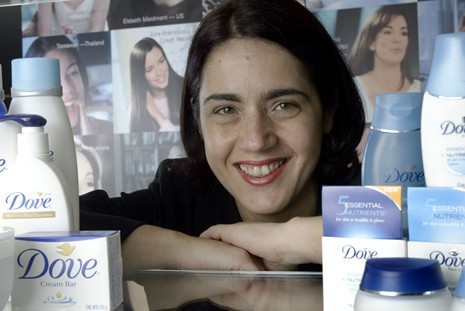
Silvia Lagnado is one of my marketing heroes. She worked at Unilever for many years shepherding the Dove brand. She created the magic of the Dove Campaign for Real Beauty with her team (who she is quick to recognize). I have had the pleasure of meeting her. She is as authentic, as passionate and as smart as you would expect.

I have learned as much from what she did at Dove as how she did it. She talks about "marketing marketing" in businesses. She makes the often misunderstood role of marketers as inspirers, interpreters and creators accessible to others, backed by her serious analytical and business chops.

This is a classic interview from 2006 conducted by Roy Young. You can see that she really listens to customers and cares. She energizes people around a bigger idea. Thank you Roy Young for capturing this moment in time. He interviewed her while researching his book on "marketing marketing." Out of respect to the source, please check it out on MarketingProfs. I hope you enjoy it as much as I do.


Profile of a Marketing Champion: Unilever's Silvia Lagnado

by Roy Young
Published on October 31, 2006
Silvia Lagnado, new group vice-president at London-based Unilever, embodies marketing championship—in particular, the ability to "span silos" by building bridges between marketing and her company's many other functions to generate cash flow. She heads a team devoted to "brand development," including conceptualizing new products and creating advertisements, packaging, and marketing strategies.
In her daily operations, she interacts with Unilever's finance, supply chain, research and development, and human resources departments. She also collaborates extensively with the many far-flung brand-building teams of salespeople and marketers operating around the world to bring the division's offerings to market.
Silvia says the most effective way to "market marketing" in an organization is to make it very personal for staff in other key positions. She advises: "Have people think about which brands they themselves really respect and which products they love—then ask them what has made them think and feel that way. They will likely discover that a marketer's efforts are behind their feelings of respect and love."
What follows is part of an interview I conducted with her to learn what makes her a Marketing Champion.
* * *
Roy Young: Tell me a bit about your background. Did you come up through the typical marketing ranks? Or was your path to where you are now more diverse?
Silvia Lagnado: I joined Unilever in 1986, in Brazil, after getting a degree in civil engineering. But I've always worked in marketing and brand development, and the work has taken me all over the world—Brazil, the United Kingdom, Argentina, and the United States.
RY: In your view, what skills have been most important to your ability to succeed on the job?
SL: I'd say it's hard work, the ability to combine strong analytical skills with intuition, the courage to take risks, integrity, and the ambition to do good work.
RY: Of all the groups with whom you and your team interact, which relationships are the most likely to experience some tension?
SL: My team's relationship with the brand-building groups is most likely to experience some tensions and complications. The brand builders are under enormous pressure to deliver our products to market every day, to both distributors and consumers. They need product mixes on time and in full from my team. If we don't have a good relationship with them, they may start perceiving us as uncommitted to the work.
RY: What steps do you take to construct a bridge between your team and the brand builders?
SL: I've found that aligning both sides behind a compelling vision is crucial. If we can both get emotionally attached to the vision—and agree on where we want to take our brands, why this is an exciting space, and how we plan to succeed there—each group can look beyond its own pressures to the more important, higher-level goals.

Tuesday, October 4, 2011

Simplicity Takes Faith

The Microsoft packaging team did an internal parody "If Microsoft Had Marketed the Ipod" in 2006 around the time they launched the Zune. It was meant to capture the classic tension between designers and the multiple product, marketing and sales teams who can painfully kill a design like death by a thousand paper cuts. But I always remembered the parody because it showed so clearly the differences between rational vs. emotional marketing and telling vs. showing.


DesignModo had a great post of emotional technology ads that also get across the one critical rational point of difference. I love looking at their technology examples, especially ones for business customers. Technology can be complex and takes even more discipline to be simple, to be clean, to be clear.  Simplicity takes fearlessness since you have to fully commit in order for it to work. Minimalism takes so much confidence and faith in consumers' hearts and minds.

"Wrong Sound. Wrong Image." - ZTrackZ Sound Design - Mexico 2009