If you are trying to learn marking on the job, here is a Pinterest Board I created of really good videos, slideshares, books, plus more. They help marketers mobilize people inside and outside of companies. They can help you understand the role of a marketer and how that is changing. It has classics, plus actionable information on the forefront of marketing. They are inspiring, practical and personal--not academic. Here is the link.
For your convenience, I categorized them with brief descriptions so you can self-serve a la carte. It is current as of today. The Brand Binge posts are at the top. This was so much fun to do. I love that marketers have such generous spirits to share and learn. Me too.
John Willshire is wise. He reminds why I love what I do and why I am so optimistic and hopeful about marketing and branding. He talks about the people in a brand's community as Blacksmiths, not salesmen.He has a beautiful way of saying this on Smithery.co:
A draft of this post has been sitting in the queue since I started this blog. I wanted to save it until I had some readers. And today is definitely the day. I couldn't be more excited to share.
Barbara Apple Sullivan is one of my marketing heroes. She founded her own agency Sullivan in 1990. She was an early Mad Woman let alone a woman-owned business on Madison Avenue. Amazing.
Barbara specializes in business-to-business branding. She helped teach me how to create simple, meaningful messaging and product architectures. I often use messaging platforms that we created together as "templates" to each other marketers. Over the past 20 years, she has gathered and mentored a posse of men and women who believe creativity, inspiration and business can go together, like Nicole Ferry and Diana Bach. Nicole has a fantastic quote on their site:
This question showed up on Quora: What does start up branding mean for an early stage company? Is it just picking a name and a logo? I have been asked this question from start ups before. There are also some similarities when an established company is piloting a new product. I wrote a short answer on Quora and then got more questions. So I answered them all in the spirit that it might help engineers and founders bring their amazing ideas to the world. I hope so.
The Brand:
Branding isn't just a logo. A logo or an ad may capture the meaning of a brand, but it can't create it.
A brand's meaning is created by every touch point a person has with a brand. So we have to make sure the people who are responsible for delivering those experiences -- employees -- understand our brand values. They have to believe. We have to believe.
I have found that start ups and their founders have audacious dreams to change the world that can make a great brand ideal.
Google started out to "democratize the world's information." Square wants to "change the way people do business." Kiva wants to "connect people through lending to alleviate poverty." Method wants to "make products that work, for you and for the planet." Pinterest is trying to "connect everyone in the world with the 'things' they find most interesting."
People don't pull all nighters at Square to process payments. They could do that at Paymentech. Square employees want to change the world. They are inspired by a leader who is trying to. You can feel it in everything they do: their design, pricing policy, tweets, plus more. The logo and name are a white square -- very generic -- which makes this point even more powerfully.
"Marketing is a tax you pay when your product is unremarkable" is a quote from Robert Stephens founder of the Geek Squad. It has taken on a mythic-ness across the Internet and is a particular favorite among tech companies. There is incredible power and importance in Robert Stephens' 11 words. Blasphemy from my marketing mouth? Not on your life.
However, I fear many people may be misunderstanding the importance of this statement. Marketing in his sentence literally means traditional advertising and paid media. Folks use his quote as yet another grenade in the battle between the product / tech and marketing teams (sad). When a launch fails, all too often the marketers point at the product team and vice versa (sadder). I believe the genius of the expression that "good products market themselves" is misunderstood and has a ton to do with a stage in a brand's life and the nature of the product. Google search, yes. Google wave, no. Google is now running Chrome advertising which will drive search traffic. Tivo was a truly great, leading product without successful marketing and it struggled. Segway?
Hmmm. Marketing isn't just communications. Semantics feel important here. Marketing means: listening and anticipating on behalf of customers for the development of new products, distribution to make it easy to learn about about and access them, the experience you create in their delivery and service, plus how you communicate about them. Marketing (aka branding) can be the meaning that flows through it all.
I am a marketer on the frontier of what we marketers do, and it is hard to explain my role in any traditional terms. My work crosses product and communications. With technology and customers' changing use of it, the traditional siloed roles of NPD, advertising, tech teams, etc. don't necessarily make sense. A perfect iconic example is Steve Jobs. Do you notice how the tech folks see him as their hero? And so do the designers, the distributors, the businessmen, the advertisers, and the marketers. I love that. He was all of them. Another perfect example I like to use is Facebook. Every consumer products company wants to work with Facebook right now because that's where the customers are. So who do you send to the meeting with Facebook? Are they a media partner? Are they a distribution and sales channel for your product? Are they actually part of your product (eg games, payments)? Are they servicing through your social media team? In a corporate org structure, you could imagine sending 20 people to Facebook across NPD, Advertising and Media, Servicing, etc. It just doesn't work that way anymore. Many technology companies are media companies and the more they can integrate the creation, curation or distribution of stories (aka content), the more those silo lines can blur. As the Internet of Things emerges and the Internet is embedded in more and more everyday objects like cars and cameras, the possibilities get even more amazing. "Marketing" or whatever we are going to call ourselves has to keep up. And when we mash the old roles up, it is so much fun. We're just getting started. Let me give some examples.
Media marketing is part of the product itself...
Facebook "likes" is a perfect example. As you use the Facebook platform, you are broadcasting your interests in a very branded way by Facebook. This works extremely well, because the product by its nature is social. But what about other products that aren't literally social themselves?
Threadless. They run t-shirt design competitions through an online social network. According to Bonfire Social Media, Threadless "revenue is growing 500 percent a year, despite the fact that the company has never advertised, employ no professional designers, use no modeling agency or fashion photographers, have no sales force, and enjoy no retail distribution." However, they do understand social media and have built an active, empowered following of hundreds of thousands of people. The shirts become the media. They all carry the Threadless brand.
Product is part of the media advertising...
For the launch of Jay-Z's biography Decode Jay-Z, Microsoft Bing and Random House literally took pages of his book and placed them where he grew up in NYC. The product itself became the advertisement, instead of the traditional "author head shot, cover art and launch date." It also gave a reason for customers to explore the Bing technology rather than watching a video demo. I love this campaign. (Interesting, from May 2010 to 2011 Bing gained search marketshare from Google. In May 2011, Google started their largest traditional campaign ever).
So back to Robert Stephens' and his quote that rang across the Internet world in 2008 and is still reverberating today. What I have since deduced is that Robert Stephens was working with Crispin Porter + Bogusky around that time. To break the finger pointing between the marketing, sales and tech teams at Best Buy (who purchased Geek Squad in 2002), I bet Stephens' and his agency Crispin threw a white flag up to the tech and product teams to shift the dialog away from advertising. Geek Squad spent a considerable budget on marketing, just not all on traditional paid media. They shifted the expensive television media budget to "bake the marketing" into the product experience. The branding on the Geek Squad cars, the uniforms for the agents, plus more. They had custom made shoes that left tens of millions of guerilla marketing imprints of the Geek Squad logo. This brand story is even more amazing to me because Geek Squad is a service, not a tangible product, and their service is not inherently social or embedded in tech.
Robert Stephens has a very unique understanding of branding and an amazing relationship with his marketers. You can see the irony in using Stephens' words to dismiss the true, forward looking marketing leaders, branders or the function all together. These are the types of marketers who the product and technology dreamers might want to find in their organizations--the marketers who truly respect what they do and who may even know how to read a little code.
When someone asks me one of the proudest and most important skills I have as a marketer, I always say collaborating with creative teams to produce amazing work--some of the proudest of their careers, I always hope. Designer Murat Mutlu has this great quote on his blog: "The process of getting a bit of paper containing a brief and turning into a real life experience is pretty great." Just think, it is the marketer's brief that needs to light that fuse. This requires translating the business, simplifying the customer insight, conveying what the product does in clear way, and tying it to a higher purpose for the brand. Most importantly, it requires talking to teams in a way they will hear you. And for designers and creative teams, that means they need to feel it.
I am not going to get into the skills of writing a kick ass brief here, more on that later. But I will dwell on inspiration and the art of briefing. As I continue to (b)log the best of the best I have found so far, this is an iconic example of how to capture inspiration in a brief by Damian O'Malley who is a savvy agency planner in Europe. He recreated the story of Michelangelo's brief for the Sistine Chapel. It also helps bring to life why creative collaborators get a wrinkle in their forehead when you literally tell them what to do: "Change this color to red." "Use the word 'joyful', instead of 'happy'". "Customers think we are X. Tell them we are Y." Creative teams work from a concept and why they are doing something, not what they are working on or how they do it. Thank you Damian O'Malley for getting this point across in such a compelling way.
Please don't perceive the comparison of creating a product or a brand to the Sistine Chapel as disrespectful. It is meant to be the exact opposite. Brands and the companies behind them create jobs, protect money, plus much more. It is an awesome responsibility that should be taken seriously and with integrity. I think branders should strive to find the significant meaning for customers, even if that means reaching for aspirational analogies like this that are very far out of our realm.
Imagine I have a beautiful face and a big butt. Am I going to spend all of my time telling men not to look at my butt? Ironically, drawing even more attention to it as I try to downplay it. Telling them that it isn't as big as they think? In other words, actively telling them that they are wrong. Or am I going to smile? Melt the room with warm laughter. Put on lipstick and draw attention to my best feature, the one that men will love?
I believe the best marketing focuses on who you are and what you stand for, rather than what you are not. Sounds crazy, right? But think about how much marketing is based on a what a product and therefore a brand isn't. It always fascinates me.
My hypothesis is that it happens most for brands and products that customers know well. There are two instances when this really seems to kick into gear: one, a company tries to grow or expand into new categories they aren't known for or two, when they are trailing a competitor who is very clear about that competitor's strength. In both situations, the company goes into focus groups and hears customers tell them this. Not surprisingly, people's impressions are largely built on the marketing and experience that brand did to create them. All of a sudden it seems like a weakness, when it may just be the success of what they just spent time and focus creating. As their internal business goals change or a market heats up, the company may turn around for the next 5 years and tell customers that isn't "just" who they are.
Some do this evolution or entry into new areas elegantly. Google's product is synonymous with search and their brand ideal is to organize and democratize the world's information. Now they are educating about Chrome. They're doing it through stories like It Gets Better or Dear Sophie. IBM meant hardware and then they needed to reinvent themselves and reorient their brand to business services through a Smarter Planet. I am a huge fan of both of these campaigns. I know exactly what they do rationally as well as their higher purpose in the world and their ideals.
But other brands do this by focusing on the negative or even worse, being defensive about their competitor's point of difference and strength. Ironically, even though these brands are listening to customers and it may come from a good place, the intent isn't translating in execution. They are looking at the customer insight too much through the lens of their business goals, rather than their brand promise. (See earlier post Listening Wrong is As Bad As Not Listening. The best communications start with a guiding customer insight: a forward-looking, fundamental truth that connects with your customers and your brand. The guiding insight is informed from customer research, as well as a connection to a brand's promise.) And as my very refined grandmother used to say, "Sweetheart, their slip is showing" in the marketplace. Their communications can appear completely focused on the company's agenda, not the customers'. Even worse, if it orients them to their competitors instead of their unique, ownable space. And it can fall wrong if not executed well, since it sounds like the company is telling the majority of customers they are wrong. It happens all the time. Start looking for it. I call it "Not Just" or "More Than" marketing.
The most meaningful brands--and personal reputations for that matter--to me aren't built on what they aren't. They focus on what they are. What they are best at and why they are different and special. They focus on their smile.
Diet Dr. Pepper is my favorite soda of all time. I don't like to showcase negative examples ever. I just don't do it. I know somewhere there is a creative team or marketing manager proud behind every piece of work and a mother who is even prouder. I figured I could do it here for this little exception because my DP addiction probably paid for it. Thanks @EuniLuni for sending it my way. Obviously, Dr. Pepper heard in focus groups that men don't drink diet because it is "for women"...
__________________________________
Addition February 27, 2012:
This was such a perfect example from one of my favorite little places that I couldn't help but add it. You can see why customers thought for years they were just bagels. It's in their name. And then they added "more than" just bagels. But what more? dinner? lunch salads? a full bakery? delivery? a coffee shop? a convenience store? a gas station?
Mary Wells Lawrence. Her story is fascinating. It made my day. Thank you, Martha Tolosa, for bringing this to our attention. Here is the full post on Adwomen. I follow them on Twitter @Adwomen. After reading their purpose, how could you not?
Every marketer should read this. "Global replace" the words advertising agency with marketing team and clients with customers in your mind as you go. This manifesto Marketing at a Point of Change was written in 1994 by the team at HHCL, a very forward looking agency of the time based in the UK. I was still in school when it was written. Yet it is so true even now. If the trajectory of marketing change is a bullet, this feels like the gun that shot it. The bullet is still going and flying fast. One of my marketing heroes says the difference between old and young isn't age. It's that young, vibrant brands believe the future is better than the past ever was. I'm not looking backwards. I'm learning so we can propel forward. It inspires me to make things even better today and to write our manifesto for the future. Please read it now, now, now.
One of my marketing heroes tells this wonderful story about a bad little boy on his Birthday. The dad is so fed up with this rotten child that he gives him a big pile of horse manure. Upon seeing it, the little boy starts jumping up and down with joy. The father is surprised and asks why he could possibly be so excited about a pile of manure. The boy replies, "Because there must be a pony around here somewhere!"
Yes, kind of gross. But also wise in many ways. In marketing, I am seeing so much focus on process and expert panels about the issues. There are whole industries based on six sigma'ing, root cause analyzing, and matrix-complaining about the gridlock in getting amazing products and creative work out the door. There will always be a million challenges and excuses in any situation, in any company, in any industry, heck in life. They can all be excuses to hide behind not doing and even worse not doing it well or the best you can for customers. Often when an amazing idea comes up, the first things that pops into everyone's minds are all the reasons it won't ever happen. Imagine if every time Muhammad Ali had stepped into the ring, he talked about all the ways he could get pummeled. He would be one crushed butterfly. What if you envision the amazing idea happening and assume it will?
In an earlier post, I talked about "Why Great Brands are Like Great Leaders" from Simon Sinek. Both brands and leaders require integrity, authenticity and most importantly the magic to inspire action. To do so successfully, you need to trust your instincts and make bold moves. You need to be accountable if they fail and ready to share credit when they succeed. Brands need inventiveness and differentiation, which by design means moving ahead and away. You will likely be around a lot of people with different goals and speaking a different financial or technical language. Frankly, if people aren't looking at you like you have 3 heads, then you probably aren't thinking big enough. I always say that when the tenth person says no then I must be on to something really amazing. Branders need to look ahead to see where the tectonic plates are moving while working through the pressure at the fault lines. In other words, great brands need great leaders.
In the spirit of encouraging strong and diverse leaders, I wanted to share this important list of 10 Rules for Brilliant Women written by Tara Sophia Mohr. For a man or woman "putting themselves out there," it is insanely true.
_________________________
10 Rules for Brilliant Women
I coach brilliant women, lots of them. Dedicated, talented, brilliant women.
Most of the time, they don’t know their brilliance. They are certain they “aren’t ready” to take on that next bigger role. They are more attuned to the ways they aren’t qualified than to the ways that they are. They are waiting for someone to validate, promote or discover them. Sound familiar?
It’s time to step up, brilliant women. Here are ten principles for owning your brilliance and bringing it to the world:
1. Make a pact. No one else is going to build the life you want for you. No one else will even be able to completely understand it. The most amazing souls will show up to cheer you on along the way, but this is your game. Make a pact to be in it with yourself for the long haul, as your own supportive friend at every step along the way.
2. Imagine it. What does a knock-the-ball-out-of-the-park life look like for you? What is the career that seems so incredible you think it’s almost criminal to have it? What is the dream you don’t allow yourself to even consider because it seems too unrealistic, frivolous, or insane? Start envisioning it. That’s the beginning of having it.
I understand that there is a gravitas to business and that people at work are busy beyond words. But why does that often translate into very rational marketing to them? Form letters. Powerpoint. Bullet lists. Stock photos.
I love that good design can be even simpler and more direct. Emotion can convey respect, trust and confidence as well as or better than a business letter. And capturing the inspiration of why people are in business can make us feel part of something bigger. Business customers are people with business needs. GE ran their iconic and successful "We Bring Good Things to Life" campaign for nearly 25 years inspiring people, even while they largely transitioned to corporate customers. Now, IBM is trying to make a "Smarter Planet".
Corporatized marketing becomes even starker when serving entrepreneurs. In trying to respect them as businesses, I often see marketing that draws from corporate tool kits. Yes, they have business needs. But they are also people who are passionate, driven, and proud to serve their own customers. Here are some examples of small business branding as food for thought.
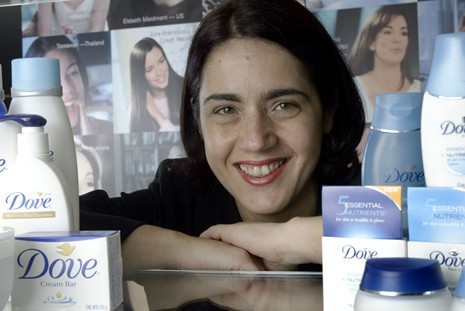
Silvia Lagnado is one of my marketing heroes. She worked at Unilever for many years shepherding the Dove brand. She created the magic of the Dove Campaign for Real Beauty with her team (who she is quick to recognize). I have had the pleasure of meeting her. She is as authentic, as passionate and as smart as you would expect.
I have learned as much from what she did at Dove as how she did it. She talks about "marketing marketing" in businesses. She makes the often misunderstood role of marketers as inspirers, interpreters and creators accessible to others, backed by her serious analytical and business chops.
This is a classic interview from 2006 conducted by Roy Young. You can see that she really listens to customers and cares. She energizes people around a bigger idea. Thank you Roy Young for capturing this moment in time. He interviewed her while researching his book on "marketing marketing." Out of respect to the source, please check it out on MarketingProfs. I hope you enjoy it as much as I do.
Profile of a Marketing Champion: Unilever's Silvia Lagnado
by Roy Young
Published on October 31, 2006
Silvia Lagnado, new group vice-president at London-based Unilever, embodies marketing championship—in particular, the ability to "span silos" by building bridges between marketing and her company's many other functions to generate cash flow. She heads a team devoted to "brand development," including conceptualizing new products and creating advertisements, packaging, and marketing strategies.
In her daily operations, she interacts with Unilever's finance, supply chain, research and development, and human resources departments. She also collaborates extensively with the many far-flung brand-building teams of salespeople and marketers operating around the world to bring the division's offerings to market.
Silvia says the most effective way to "market marketing" in an organization is to make it very personal for staff in other key positions. She advises: "Have people think about which brands they themselves really respect and which products they love—then ask them what has made them think and feel that way. They will likely discover that a marketer's efforts are behind their feelings of respect and love."
What follows is part of an interview I conducted with her to learn what makes her a Marketing Champion.
* * *
Roy Young: Tell me a bit about your background. Did you come up through the typical marketing ranks? Or was your path to where you are now more diverse?
Silvia Lagnado: I joined Unilever in 1986, in Brazil, after getting a degree in civil engineering. But I've always worked in marketing and brand development, and the work has taken me all over the world—Brazil, the United Kingdom, Argentina, and the United States.
RY: In your view, what skills have been most important to your ability to succeed on the job?
SL: I'd say it's hard work, the ability to combine strong analytical skills with intuition, the courage to take risks, integrity, and the ambition to do good work.
RY: Of all the groups with whom you and your team interact, which relationships are the most likely to experience some tension?
SL: My team's relationship with the brand-building groups is most likely to experience some tensions and complications. The brand builders are under enormous pressure to deliver our products to market every day, to both distributors and consumers. They need product mixes on time and in full from my team. If we don't have a good relationship with them, they may start perceiving us as uncommitted to the work.
RY: What steps do you take to construct a bridge between your team and the brand builders?
SL: I've found that aligning both sides behind a compelling vision is crucial. If we can both get emotionally attached to the vision—and agree on where we want to take our brands, why this is an exciting space, and how we plan to succeed there—each group can look beyond its own pressures to the more important, higher-level goals.
Gloria Steinem is a funny, eloquent and inspiring speaker, but she wasn't always. She tells a fantastic story about her early years raising awareness for women's rights. She would go with index cards in hand and quote stat after stat, and as she said, put the crowd to sleep. Her mentor in the movement said to her: if you have an elephant standing on your foot, are you going to rationally describe its dimensions, its weight, and the physics of how long it would take to move it? Or are you going to start screaming?
I have always loved that story. It makes me think about the passion and inspiration required for leadership. Great brands are like great leaders. Simon Sinek explained this so well in his TED talk "How Great Leaders Inspire Action." He talks about the importance of starting with "why" not just "what" you do. He gives this incredible example about Martin Luther King, Jr. What if he had gone to the Mall in Washington, D.C. with a 12-point plan? No, he had a dream.
When brands are at their very best, they can earn a role in our success, confidence and happiness. But that takes integrity, empathy, and the ability to motivate followers--all powerful qualities of great people. Great brands need great leaders.
I have become obsessed with the possibilities of technology like Blippar for service and branding. Blippar is a new app launched in Europe that uses the latest image recognition technology to make an advertisement itself a trigger for virtual content. In other words, it is a step toward more user-friendly augmented reality. Here is a demonstration (You can download the app in the US, but only UK brands have content at this time. So I haven't be able to use it firsthand yet):
Obviously, these are basic ads so far and 3D-ifying websites since it just launched. But think of where this could go to help customers. Marketers could re-imagine customer service. Imagine putting "help" videos and 3D images in context if people struggle to put shelves together! The help images could be triggered by the instructions or by the furniture pieces themselves. Imagine if a student studying with an SAT-prep guide could have inspirational Easter Eggs from other students cheering them on and sharing tips. Even more amazing, think if they aimed their phone where they were struggling and a teacher appeared to talk them through that problem.
Marketers could bring brand stories to life in the experience. Imagine scanning a menu and seeing it change from words to artful dishes and maybe even how the Chef prepares them. Imagine looking at chocolates in Whole Foods and being able to see the beautiful story of cacao harvested in Peru with a quick aim of the phone at the packaging.
I believe "creative" technology that dares to interrupt you has to be easy and quickly clear that it is worth it. That is one of the reasons I have struggled so far with inserting QR codes in an experience. But also why I am so optimistic about companies like Blippar and what marketers will be able to do with technology like this as it gets even better. I feel like it could be less about brand interruption and more about enhancement.
Thanks TNW Apps for your article that brought Blippar to my attention.
Matli provides a simple view of the four stages of a company and its brand: new, growth, mature and revival. He also provides pithy, modern brand examples in the article.
New Brands (Create) Primary Challenge: Differentiation and Targeted Awareness
"In the early stages of a brand launch, the question that you continually hear is 'What is it?' Distinct, simple, and viral differentiation create the potential for explosive growth. But most significant, it is the relevance to an early-adopter audience that catapults...a brand past the new, start up phase and into the growth phase."
Example: TOMS Shoes
Growth Brands (Build) Primary Challenge: Transitioning from Early Adopters to Mass Market Without Alienating Core Fans
"Owners of hot, new brands commonly mistake their rabid and vocal fan base support as something long term that will carry their brands into the mainstream. That is only true when it is carefully managed. It is critical, in this phase, to strategically shift to a simple brand message, using the short-term support of early adopters...The chief challenge in the growth stage is to achieve clarity of brand standards, messaging, tone of voice, philosophical stance, and values."
Example: Books adapted for screen like Harry Potter
Mature Brands (Leverage) Primary Challenge: Growth Against "Cooler" Upstart Competitors
"When a brand has become a household name, marketing has become a core internal function. Growth becomes difficult to maintain because of the sheer weight of the brand's size and awareness makes it challenging to constantly refresh. Senior management seeks new ways to increase brand relevance...Continuing growth with world-straddling brands requires not only maintaining relevance with the core audience but also constantly expanding into new taste-makers niches, markets and brand extensions. That process forces a brand to become more diverse in execution and often softens a brand positioning, unless it is carefully managed. Brands risk not accurately identifying their key differentiation points and skillfully translating those attributes into broader marketing strategies...That can take years, just as the brand took years to build. Brand managers may eventually find that the brand they own has become a commodity with little value."
Example: Ocean Pacific
Revival Brands (Evolve) Primary Challenge: Regain Relevancy
"When a brand has been a household name with a broad fan base for a generation or more, brand managers settle into a routine and stop giving much thought to differentiation, awareness, and new competitors...Many companies with such brands tend to hire managers with experience in maintaining a business, but little experience in brand extension, differentiation, or repositioning -- skills essential to maintaining relevance when dramatic shifts occur in the marketplace. And they always occur...At that point, it's critical that strong brand leadership act quickly to re-establish the brand's core relevance in the minds of its consumers....A brand may be well known but so ubiquitous that it becomes background noise, and people forget why it's special. Relevance in a fresh context can become a growth engine for older brands."
Example: Sesame Street
Here are timeless insights on building a brand from Jeff Bezos about Amazon. I love it when marketers use the same voice to talk about customers as they do to talk to them. The brand and business strategies are very sincerely intertwined. These insights are excerpts from "Jeff Bezos on Word-of-Mouth Power" written by Robert D. Hof printed in August 2004 in Bloomberg Businessweek. I recommend reading the complete interview at its source.
________________________________________________ Written by Robert Hof @ Bloomberg Business Week: Q: How did you build Amazon's brand at the start?
A: We firmly believe that for us, the right way to build a brand is by delivering a great service. Customers learn about who we are as a result of interacting with us. A brand for a company is like a reputation for a person. You earn reputation by trying to do hard things well. People notice that over time. I don't think there are any shortcuts.
Q: How important is advertising to building the brand?
A: We don't do any television advertising, and we take all of the money that we would put into television advertising, and instead put it into things like free SuperSaver shipping [free shipping on most orders over $25], lower product prices, category expansion, and invention of new features.
We take those funds that might otherwise be used to shout about our service, and put those funds instead into improving the service. That's the philosophy we've taken from the beginning. If you do build a great experience, customers tell each other about that. Word of mouth is very powerful.
Q: Even with all the publicity you got at the start, do you think word of mouth was the most important thing that built the brand early on?
A: Absolutely. The thing that we did early on is that we made it very easy for people to find very obscure products. That was something people remarked on. If you're not doing something that people will remark on, then it's going to be hard to generate word of mouth.
Q: How do you do that?
A: The only way to do this consistently over time is through invention. We work hard at being very customer-obsessed and expressing that through innovation. If you look at the kinds of things we do on our Web site and in our fulfillment -- things like free SuperSaver shipping -- basically throughout our entire organization, we're working on trying to make things better.
We see our customers as invited guests to a party, and we are the hosts. It's our job every day to make every important aspect of the customer experience a little bit better. We have a big team of people who from the very beginning have thrived on that. They're attracted to the idea of inventing on behalf of customers.
Q: How important was and is a sense of community to building the brand?
A: The word "community" can be used very broadly, so you have to pin down what you mean by it. We mean neighbors helping neighbors make purchase decisions. So we allow negative customer reviews. That's part of our brand.
When we first started doing it, it was very surprising to people that we allowed them. Now, people are accustomed to them, so they don't see them as remarkable, but when we first did it, we got letters from publishers saying, "Maybe you don't understand your business. You make money when you sell things."
Our point of view is, no, we make money when we help customers make purchase decisions. Negative reviews are helpful in making purchase decisions. So it's a very customer-centric point of view. Negative reviews will be helpful for customers, and that will ultimately sell more products than if you tried to cherry-pick the reviews.
Q: How would you articulate the Amazon brand to someone who hadn't heard of it?
A: It's about starting with the customer and working backward. And it's about invention. Our two very strong cultural attributes at the company are innovation and customer obsession. We don't want to start with an idea and work toward the customer. We want to start with a customer problem and then invent to a solution. That's how we approach everything we do.
Brands always limit what you can do. For us, it would start to tarnish our brand if we did things in a me-too kind of way or where there wasn't any invention to solve a customer problem.
I'll give you a concrete example. I get asked all the time, "Why don't you leverage your brand name by opening physical stores?" The problem is, we don't know how we would do that better. It's a well-served space. The people who operate physical stores today do an excellent job, and if we were to do that, we would not be improving anything. So that would hurt our brand reputation.
Q: Do you have in mind a particular type of customer whose needs you try to meet?
A: Yes, we do. We take the point of view that our customers are smart. If you do things well, and you do what customers actually want, they will figure it out. I don't know if that sounds obvious, but I think it's actually a fairly rare approach. People make assumptions all the time: "That might be a good way to do it, but people won't recognize the value in that."
Q: Is traditional branding, which attempts to create an image that is not necessarily related to performance, appropriate in a relatively transparent medium like the Web?
A: What you absolutely cannot do -- but you do see businesses try this -- is they pretend to be something they're not. Even when people do advertise, the ones who advertise effectively are those who figure out what real value they genuinely bring, and then they shout about that.
Q: It's getting more difficult to reach mass markets effectively. How does Amazon reach its 30 million-plus customers?
A: Let's say your customer base is a very narrow market. Then you use a sales team and you go market individually to those customers. Likewise, if to make your business successful, you need 100 million customers, then you buy a lot of national TV coverage, and that could work.
The problem is usually reaching that hard middle. If you have a service that needs 15,000 customers, it's too big to effectively use a sales force, and it's way too small to use television advertising.
I think those middle-sized audiences are what we serve. That's exactly the kind of product that a book publisher has. A typical mid-list book will sell 15,000 copies. What we're very good at doing is finding 15,000 readers for a mid-list book. All the discovery tools that we've built are dedicated to that kind of purpose. So for me, that's the big change.
Q: What do you think accounts for the rather steep increase in the value of your brand? Is there any particular thing that you've done lately?
A: I think that it's continued focus on all the fundamentals -- selection, lower product prices, better availability, better discovery tools, better information about products. One of the things that's starting to happen is that people are recognizing that we sell things like electronics, kitchen, and home products. So there may be a tipping-point phenomenon happening, where a larger group of people are starting to recognize that. But that's something we've been working on for four years. It's not anything new.
There is humanity in branding. Thank you Robert Blanchard for summing it up so well.
“A brand is the personification of a product, service or even entire company. Like any person, a brand has a physical “body”: in P&G’s case, the products and/or services it provides. Also, like a person, a brand has a name, a personality, character and a reputation. Like a person, you can respect, like and even love a brand. You can think of it as a deep personal friend, or merely an acquaintance. You can view it as dependable or undependable; principled or opportunistic; caring or capricious. Just as you like to be around certain people and not others, so also do you like to be with certain brands and not others. Also, like a person, a brand must mature and change its product over time. But, its character, and core beliefs shouldn’t change. Neither should its fundamental personality and outlook on life. People have character … so do brands. A person’s character flows from his or her integrity: the ability to deliver under pressure, the willingness to do what is right rather than what is expedient. You judge a person’s character by his/her past performance and the way he/she thinks and acts in both good times, and especially bad. The same is true of brands.”
Robert T. Blanchard of Procter & Gamble in his 1999 “Parting Essay”
Building a meaningful brand takes integrity, caring, believing, designing, and listening. It means learning, which I have been doing humbly and voraciously over time. I have long kept notes of things that made me go hmmm. Now I am posting them here for others who may be interested and who share my spirit of striving to make marketing even more meaningful.


 by Alex Bogusly and John Winsor. You can also read more about the original Geek Squad branding in this 1999 article in
 .JPG)


 by Bob Lamons. It's a good, basic read. I've bought many copies and they always go missing...